Corporate Tax Registration
In accordance with the recent amendments to the Corporate Tax Law in the United Arab Emirates (UAE), effective as of 2024, Reyson Badger reiterates its commitment to offering professional and specialized corporate tax registration services in UAE. Ensuring that our clients comply with the proper requirements and regulations of the UAE government remains at the heart of our primary objective. Effective 1 March 2024, entities required to register for UAE Corporate Tax but failing to do so may incur an administrative penalty of AED 10,000, as prescribed in Cabinet Decision No. 10 of 2024.

The MoF announced in January 2022 that they would bring in Corporate Tax on the business's net profit. Following that, the corporate tax came into effect on 1 June 2023 and 1 January 2024, depending on the financial year of the respective businesses. As soon as the Corporate Tax was announced, most of the auditors and Audit Firms in Dubai came up with Corporate Tax Registration Services in the UAE. The UAE Government has strictly followed the best rules and regulations that have been put out by OECD(Organisation for Economic Co-operation and Development).
Corporate Tax Registration Services
Juridical Persons in the UAE, foreign juridical persons managed and controlled in the UAE, foreign juridical persons who operate through permanent establishments in the UAE or with a taxable nexus in the UAE, and natural persons engaged in a business activity must register for Corporate Tax in the UAE.
Upon completing the corporate tax registration services in Dubai, the registered person/entity will receive a Tax Registration Number. Tax returns for a tax period should be filed within nine months of the effective end date of the period. As specified by the Minister, some cases excluded from corporate tax must be filed separately with the Federal Tax Authority.
Who Needs to Register for Corporate Tax in the UAE?
All persons designated by the Corporate Tax law as taxable persons must register for UAE Corporate Tax and obtain a TRN, regardless of whether they currently have taxable profit. The following companies/persons are required to register for Corporate Tax in UAE.
1. Companies Registered in the UAE
Any business incorporated in the UAE on the mainland or in a free zone has to register for corporate tax if it conducts business. Depending on the nature of the business, there are also opportunities for exemptions.
2. Revenue Threshold
Registration is required for entities classified as taxable persons- it is not determined merely by meeting a revenue threshold.
3. Free Zone Enterprises
Free zone entities that qualify for a 0% corporate tax rate must still register for corporate tax and submit required filings to retain their qualifying status.
4. Foreign Enterprises with Fixed Presence in UAE
Foreign bodies with a fixed presence, with branches or long-term contracts in the UAE, must register for corporate tax.
5. Exempted Bodies
Bodies such as governmental agencies or qualifying public benefit organizations may be required to register to evidence their exemption status.
6. Individual Freelancers
Natural persons (freelancers or self-employed) whose turnover from business activities exceeds AED 1,000,000 in a calendar year are required to register for corporate tax.
Points to Remember
- Register within the timeline, so that you do not face fines, and follow the guidelines provided by the FTA.
- Check the FTA website regularly for latest updates and news, so you do not break tax rules due to the threshold or law.
- Free zone businesses must still register even if their tax is reduced or exempted.
Who is Exempt from Corporate Tax?
In the UAE, certain entities and individuals are exempt from Corporate Tax under specific conditions. However, even if an entity is exempt, it may still need to register with the Federal Tax Authority (FTA) and comply with certain administrative requirements. The following entities are generally exempt from Corporate Tax in the UAE:
- Government Entities: Departments, authorities, and other public institutions that are part of the federal or emirate governments are exempt from CT.
- Government-Controlled Entities: Companies wholly owned and controlled by the government, provided they meet specific criteria, are exempt.
- Extractive Businesses: Businesses engaged in the extraction and exploitation of natural resources, such as oil and gas, are exempt from CT.
- Non-Extractive Natural Resource Businesses: Entities involved in non-extractive activities related to natural resources may also qualify for exemption.
- Public and Private Pension or Social Security Funds: Funds established to provide retirement or social security benefits are exempt from CT.
- Qualifying Investment Funds: Investment funds that meet certain regulatory criteria can benefit from CT exemptions.
- Wholly Owned and Controlled UAE Subsidiaries of Certain Exempt Persons: Subsidiaries that are entirely owned and controlled by exempt entities may also be exempt from Corporate Tax.
What Documents are Required for Corporate Tax Registration in UAE?
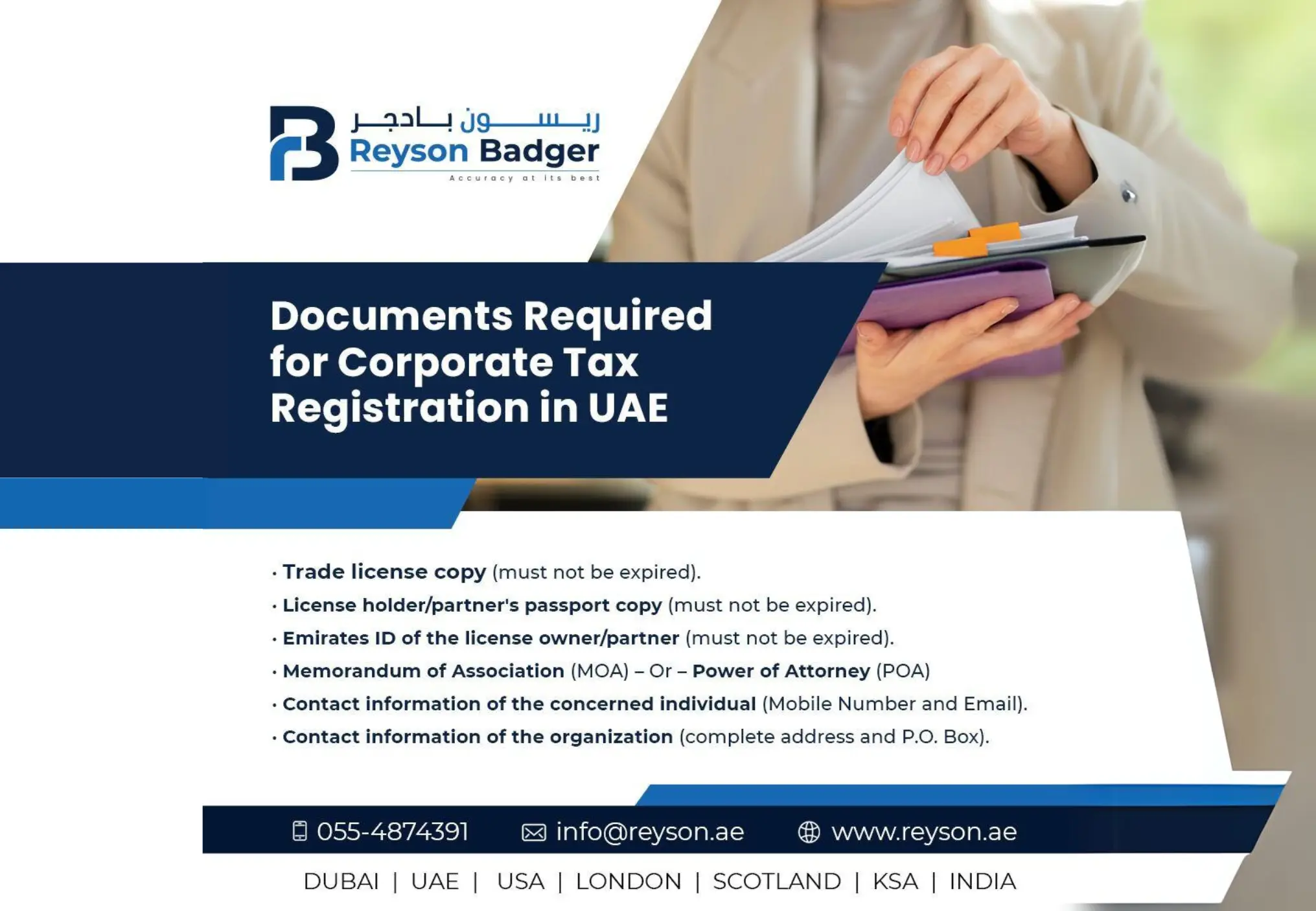
These are the fundamental paperwork requirements for the registration procedure. However, there can be further requirements or actions necessary based on the company's specific structure or if you are a foreign company.
- Valid Trade License or Certificate of Incorporation
- Identity Documents of Authorized Signatories (Passport/Emirates ID)
- MoA/PoA (Memorandum of Association/Power of Attorney)
- Financial Statements or Equivalent Supporting Documentation
- And any other documents requested by the FTA depending on the entity structure
Essential documents for Corporate Tax Registration in UAE
Overview of Corporate Tax Registration Process
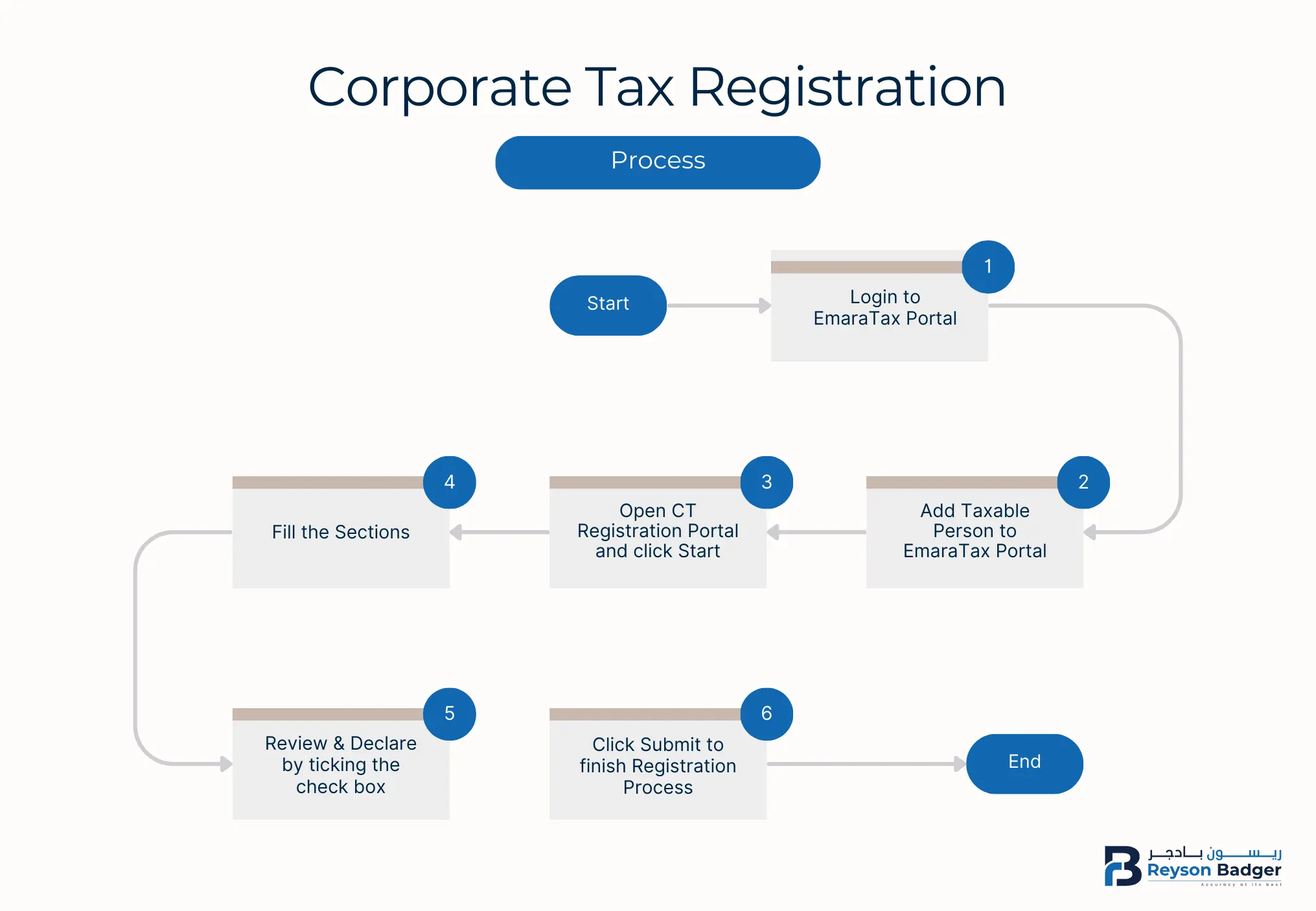
Corporate Tax is registered through the Emara Tax Portal of the FTA. EmaraTax is the official online portal that can be used to register for taxes, make VAT payments, comply with regulations, file returns, and de-register. The user may create a new account or login with their existing account if they already have one. It is highly likely that you already have an account if you have already registered for VAT. It is also possible to access the portal via the UAE Pass if you do not have an FTA account.
Corporate tax registration services in Dubai can be conveniently completed through the Emara Tax Portal. Firstly, login to the portal and then add taxable person. As the next step, open the corporate tax registration portal and fill all the necessary fields. Review the details and click the check box to confirm the details. Finally, click submit button to complete the registration process. You can refer our article for more detials on the step-by-step corporate tax registration process.
Download Official Corporate Tax Registration Guide
What Happens After Submitting Your UAE Corporate Tax Registration?
Following the submission of an application, FTA will approve, reject, or request resubmission of all necessary information and subsequently inform the applicant.
- A notification will be sent to you by email if the FTA requires any additional information concerning your application.
- On Acceptance of your Corporate Tax Registration, the FTA would inform you of the decision.
- Your Application Status on the Dashboard would be updated accordingly. Check your Corporate Tax Registration dashboard subsequently.
Corporate Tax Registration Deadlines
| Entity Type |
Condition |
Corporate Tax Registration Deadline |
| Resident juridical persons |
Licensed before 1 June 2023 |
Must register by 31 May 2024 |
| Licensed between 1 June 2023 and 31 December 2023 |
Register within 6 months from the end of the first financial year |
| Licensed on or after 1 January 2024 |
Register within 3 months from the end of the first financial year |
Non-Resident juridical persons
BEFORE 1 March 2024 |
Has a Permanent Establishment (PE) in UAE |
9 months from date PE existed |
| Has a UAE Nexus (no PE) |
3 months from 1 March 2024 |
Non-Residents juridical persons
ON or AFTER 1 March 2024
|
Has a Permanent Establishment (PE) |
6 months from date PE existed |
| Has a UAE Nexus (no PE) |
3 months from date nexus is established |
| Natural Persons |
Resident Natural Person exceeding turnover threshold |
31 March of the following Gregorian year |
| Non-Resident Natural Person exceeding turnover threshold |
3 months from becoming subject to tax |
Important Note
Failure to register within the above timelines will attract administrative penalties under Cabinet Decision No. 75 of 2023
Exempt Persons:
Entities Exempt from Corporate Tax: Certain exempt entities are still required to register for CT. The deadlines for these entities are specified in the FTA's Decision No. 3 of 2024.
Upcoming Corporate Tax Registration Deadline UAE
The United Arab Emirates' Federal Tax Authority (FTA) has set the corporate tax registration last date as March 31, 2025, for natural persons conducting business activities within the UAE to register for Corporate Tax. It's always advised to refer the FTA website for latest news and updates on Corporate Tax.
Penalties for Non-Compliance with Corporate Tax Registration in UAE
In February 2024, the Ministry of Finance (MoF) issued Cabinet Decision No. 10 of 2024, which published an adjustment to the Violations and Penalties concerning the terms of Cabinet Decision No. 75 of 2023 on the administrative penalties for violations of the application of Federal Decree-Law No. 47 of 2022. According to Cabinet Decision No. 10 of 2024, the Corporate Tax registration penalties will take effect on March 1, 2024.
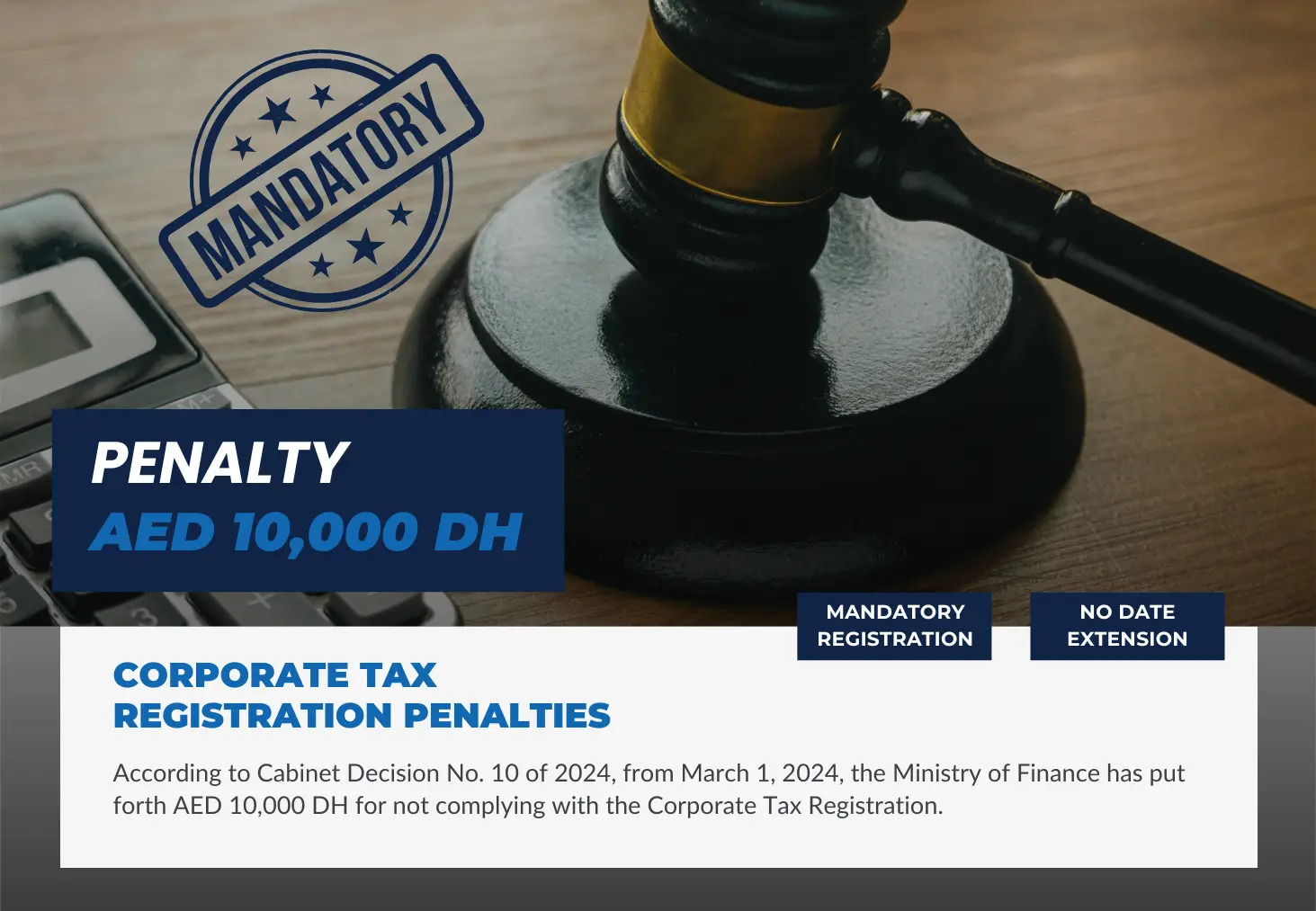
Businesses that do to comply with the Corporate Tax registration in the UAE will face an AED 10,000 penalty from March 1, 2024. For businesses with tax periods in January or February, registration must be completed by May 31, 2024. This would be the first tax period undergoing the registration process, and subsequently will be followed by other dates.
Penalties for not completing corporate tax registration in the UAE
Expert Corporate Tax Registration Services in UAE
Get expert guidance and support from Reyson Badger, one of the top corporate tax registration service provider. Our team of seasoned professionals will help you navigate the complexities of Corporate Tax registration, ensuring you avoid penalties and focus on growing your business. Don't miss the deadline! Register for Corporate Tax today and secure your business's future. Get in touch with us to learn more about our Corporate Tax registration services in Dubai, and let us handle the complexities for you. Register now and ensure compliance with confidence!
FAQs
Q1. Who is allowed to submit a Corporate Tax registration amendment application?
You can submit the application yourself as a Corporate Tax registrant, or it can be handled on your behalf by your registered tax agent or legal representative with the FTA.
Q2. Can I submit more than one registration amendment application?
No, you can’t. If an amendment application is already under review by the FTA for the same account and tax type, you must wait until it is completed before submitting another one.
Q3. How to check TRN online in UAE?
To check your TRN number in UAE, follow the steps
1. Open the FTA website.
2. On the right side panel, you can see a button named 'TRN' that helps for 'TRN verification'
3. Click on it and enter the TRN number you wish to verify
4. On submitting the details, you will get the status of your TRN
Q4. How to check corporate tax registration status in UAE?
To check your corporate tax registration status, follow the steps
1. Go to the FTA's official Status Check Page
2. Enter your SRN (Service Request Number), the number provided when you submitted your corporate tax registration application
3. Complete the CAPTCHA and view your registration status
Q5. How many days does it take for registration after applying?
Submitting the Corporate Tax registration application via EmaraTax normally takes about 30 minutes; the FTA’s review and approval may require additional time depending on the completeness of the submitted information.
Q6. How can I correct the name of the company in the corporate tax registration certificate if I had entered the name of the company incorrectly?
Contact the FTA directly to request a correction. You'll need to provide documentation supporting the correct company name.
Q7. How to register corporate tax for Group TRN?
Registering for a Group TRN requires a single application covering all group members. Consult the FTA website or a tax advisor for detailed instructions.
Q8. What if my company is an online business and not VAT registered?
Follow the same registration process, but ensure you provide the required documents and information for online businesses
Q9. How to get a Certificate of Incorporation?
Obtain the Certificate of Incorporation from the relevant UAE authority where your company was incorporated (e.g., Department of Economic Development).
Q10. Is the Certificate of Incorporation and MOA the same?
No, they are not the same. The Certificate of Incorporation confirms the company's existence, while the MOA outlines the company's structure and operations.
Q11. If we don't have a Certificate of Incorporation, can we put the date mentioned on MOA as the incorporation date?
No, use the first trade license issuance date as the incorporation date if you don't have a Certificate of Incorporation.
Q12. At the beginning, should it be the person's name or the company name?
If you have not yet created an account on Emara tax, it means you are not registered on the Emara tax portal. Once you have entered the portal, you will begin by providing your personal information. Subsequently, in both cases - when creating a taxable person or during the registration process - you will be prompted to enter the company details.
Q13. What are the steps after receiving the welcome guide for Corporate Tax registration?
- Obtain a Tax Registration Number (TRN) from the Federal Tax Authority (FTA) website.
- Gather required documents (business registration, trade license, identification documents, MOA, financial statements).
- Complete the registration application on the FTA portal with accurate information.
- Apply with attached documents.
- Await FTA approval, providing additional information if requested.
- Receive the Tax Registration Certificate upon approval.
- Understand tax obligations (filing deadlines, tax rates, payment procedures).
- Prepare for tax filing by maintaining accurate financial records.
- File corporate tax return by the due date, reporting income, expenses, and tax liability.
- Pay taxes owed to FTA on time to avoid penalties.
- Stay updated on tax regulations through the FTA website or a tax advisor.
Q14. I have a professional license for a sole establishment with 100% ownership in Dubai mainland, created on March 4, 2024. I haven't registered for corporate tax yet. Do I need to register?
Yes, it is recommended to register for corporate tax as soon as possible, even if you're not actively operating or don't have a physical office location.
Q15. Why do I need to register if I'm not operating?
The UAE's Corporate Tax law requires all businesses, including inactive ones, to register and file tax returns. Failure to register may incur penalties and fines.
Q16. What if I don't have an office location?
Having an office location is not a requirement for corporate tax registration. Even if you do not have a physical presence, you can register and comply with tax requirements.
Q17. What are the consequences of not registering?
Non-registration may lead to:
- Penalties and fines
- Difficulty in obtaining or renewing licences
- Challenges in opening bank accounts or conducting business
Q18. How to choose a corporate tax period in the UAE?
To choose a corporate tax period in the UAE, follow these steps:
1. Understand the UAE's corporate tax law: Familiarize yourself with the UAE's corporate tax regulations and requirements.
2. Determine your company's financial year-end: Choose a financial year-end date that aligns with your company's business cycle and industry practices.
3. Consider the following options:
- Calendar year (January 1 to December 31)
- Financial year (e.g., April 1 to March 31)
4. Align with group company or parent company: If applicable, align your financial year-end with theirs for simplified reporting and compliance.
5. Consult with a tax professional: Seek advice from a tax expert to ensure your chosen tax period complies with UAE regulations and suits your company's specific needs.
6. Notify the Federal Tax Authority (FTA): Once chosen, notify the FTA and ensure you meet all necessary reporting and filing requirements.
Q19. What are the benefits of choosing a calendar year as the corporate tax period?
Choosing a calendar year (January 1 to December 31) simplifies tax compliance and aligns with international financial reporting standards.
Q20. Can I change my corporate tax period later?
Yes, but you must notify the FTA and obtain approval. It's recommended to consult a tax professional before making any changes.
Q21. Are there any exemptions from corporate tax in the UAE?
Yes, certain entities are exempt from corporate tax in the UAE. These include government entities, government-controlled entities, extractive businesses (oil and gas companies), and non-extractive natural resource businesses, provided they meet specific conditions. You can learn more about it here.
Q22.Can businesses claim deductions under the UAE corporate tax system?
Yes, businesses can claim deductions for certain expenses, including:
- Operating Expenses: Costs directly related to business operations.
- Depreciation: Depreciation of fixed assets.
- Employee Salaries: Wages and benefits paid to employees.
- Interest Expenses: Interest on business loans (subject to limitations).
- Bad Debts: Specific provisions for bad debts (subject to conditions).