E-Invoicing Services in UAE
The UAE has been making strategic advancements toward a more digital, efficient, and transparent taxation system, reflecting its broader vision for digital transformation across public and private sectors. This shift aims to streamline tax processes, improve compliance, and reduce reliance on paper-based documentation.
Central to this initiative is the introduction of the E-Billing System and the upcoming e-invoicing mandate, set to be implemented by July 2026.The use of e-Invoicing UAE will become mandatory for all B2B and B2G transactions starting in July 2026. This initiative seeks to modernize invoicing practices, enabling real-time reporting and easier tax management for businesses. The government’s overarching goals for these efforts include fostering a digital economy, reducing paper usage to support environmental sustainability, and enhancing tax compliance and transparency — areas where a qualified tax consultant can offer valuable guidance and support. E-invoicing in the UAE is based on the 5-corner Peppol model, which ensures standardization and efficiency.
What is E-Invoicing in UAE?
E-invoicing in the UAE refers to the issuance, receipt, and storage of invoices in a structured electronic format, commonly XML, that facilitates seamless digital handling. This approach replaces traditional paper or PDF invoices, enabling businesses to automate and integrate invoicing processes directly with their accounting and financial software. E-invoicing is a mandatory requirement for VAT-registered businesses as enforced by the UAE’s Ministry of Finance (MoF), ensuring consistent compliance with tax regulations and promoting a more efficient, transparent tax ecosystem.
The UAE e-invoicing system uses the PINT AE format, which helps keep all invoices clear, accurate, and easy for different systems to understand. This format follows the rules of the PEPPOL network, which connects businesses and the Federal Tax Authority for safe and smooth invoice exchange.
Every e-invoice includes important details such as the name and address of the supplier and buyer, their tax registration numbers, item details, invoice date, total amount, and a digital signature. These details are listed in what is called the PINT AE Data Dictionary.
Each field has clear rules about how the information should be written. Some fields are required, like the TRN and invoice date, while others such as project name or reference number are optional. Following these rules helps make sure your invoices are accepted by the Federal Tax Authority and makes trading with other countries easier.
Importance of E-Invoicing in UAE
The UAE's adoption of e-invoicing is a vital part of its strategic vision for digital transformation and economic modernization. This system aligns with global trends, as many countries adopt similar frameworks to enhance transparency and efficiency in tax administration. The primary motives for implementing e-invoicing in the UAE include improving VAT collection, reducing tax fraud, and fostering a more transparent and sustainable business environment. By digitizing invoicing processes, the UAE aims to encourage efficiency, promote environmental sustainability through paper reduction, and strengthen overall financial governance.
E-Invoicing Requirements in UAE
The UAE has established a formal electronic invoicing regime via new legislation and ministerial decisions (e.g. Ministerial Decision No. 243 of 2025 / Ministerial Decision No. 244 of 2025), which set out mandatory e-invoicing rules for businesses.
Technical & Procedural Requirements
To comply with UAE e-invoicing regulations, businesses must ensure the following:
- Structured Digital Format: Invoices and credit notes must be generated in machine-readable formats such as XML or JSON, following standard schemas (e.g. using UBL( Universal Business Language), or the localized invoice standard for UAE such as Peppol PINT AE / PINT-UAE.
- Transmission via Accredited Service Provider (ASP): All electronic invoices/credit notes must be issued and transmitted through an ASP approved by Federal Tax Authority (FTA) / Ministry of Finance (MoF). Private paper invoices or PDFs will no longer be valid under the e-invoicing mandate.
- Data Fields & Content Requirements: Each e-invoice must include mandatory data fields defined in the FTA’s data dictionary: supplier and buyer details (including TRNs where applicable), invoice number, issue date, description of goods/services, quantities, unit prices, taxable amount, VAT amount and rate, total payable amount, and any other information required under VAT law.
- Real-time / Timely Reporting & Submission: E-invoices (and credit notes) must be transmitted and reported via the system within the timelines prescribed by the Ministry (e.g. within a specific number of days from date of issuance or supply).
- Integration & System Readiness: Businesses must ensure their ERP/accounting or billing systems are updated to generate e-invoices in the required structured format, integrate with ASPs, and support secure digital issuance, transmission, and storage.
- Electronic Storage & Archiving: Issued and received e-invoices and credit notes must be stored electronically, in compliance with record-keeping obligations under UAE tax law.
- Support for Credit / Debit Notes and Agent / Self-Billing Scenarios: The e-invoicing system also covers issuance of electronic credit (or debit) notes where applicable, and other billing scenarios like self-billing or agent billing, provided compliance conditions are met.
Benefits of e-Invoicing for Our Business Community
Implementing e-invoicing offers numerous advantages, including:
- Faster invoice processing and payments: Automation reduces manual intervention, improving cash flow.
- Real-time error detection and correction: Automated validation reduces mistakes, delays, and invoice disputes.
- Enhanced VAT compliance and streamlined audits: Real-time data reporting simplifies audits and lowers compliance risks.
- Better Data security & reliable record-keeping: Digital storage ensures invoices are securely archived and easily retrievable.
- Cost savings automation and reduced manual effort: Reduced paper use and manual processes cut administrative costs.
- System integration: Seamless connection with ERP and accounting software enhances operational efficiency.
- Data insights: Better analytics support smarter financial and operational decisions.
How e-invoicing works?
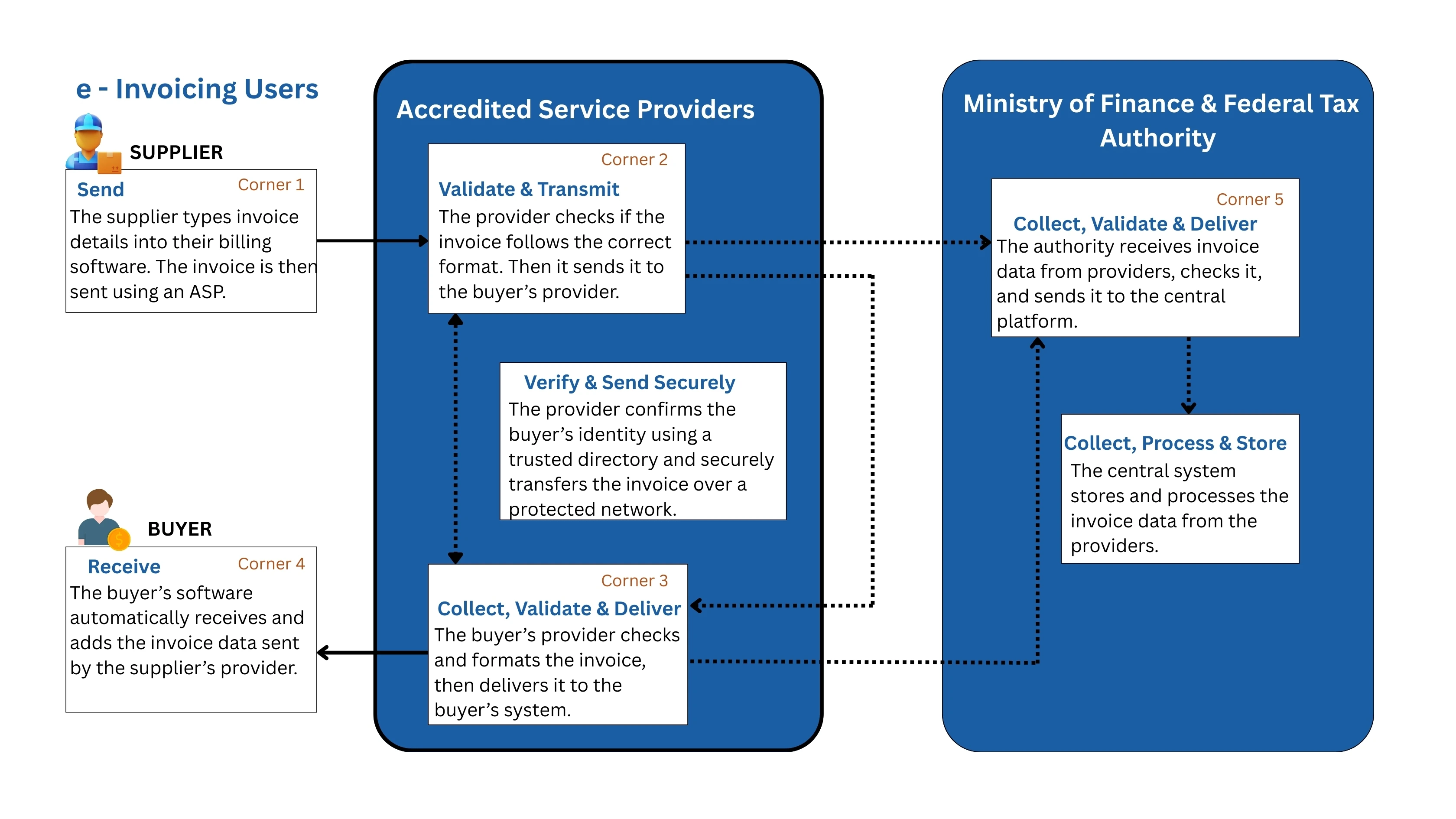
CTC e-invoicing in the UAE follows the Peppol 5-corner model and is known as the "DCTCE" model. The process of e-invoicing in the UAE can be summarized in these steps:
- Corner 1: The supplier starts the procedure by entering the invoice information into their billing program. The invoice is then sent using an Accredited Service Provider (ASP).
- Corner 2: Supplier's Service provider receives the invoice from the supplier. Its role is to validate and transmit the invoice, ensuring it follows the correct format. Following verification, the invoice is forwarded to the customer's service provider. (Corner 3). It also sends the invoice data to the central platform (Corner 5).
- Corner 3: Buyer's Service provider receives the invoice from the supplier's service provider. It collects, validates, and delivers the invoice, checking its contents and formatting. It then delivers the invoice to the buyer's system.
- Corner 4: The buyer's software automatically receives the invoice data sent by the supplier's provider.
- Corner 5: Ministry of Finance & Federal Tax Authority, The central authority receives invoice data from both the supplier's provider (Corner 2) and the buyer's provider (Corner 3). It collects, validates, and delivers this data, sending it to its central platform for storage and processing. The central platform's role is to collect, process, and store the invoice data from the providers.
E-invoicing compliance in the UAE is being rolled out in phases, and most VAT-registered businesses will need to adhere to the new requirements. The system will be phased in starting 2026, with large businesses, smaller companies, and government entities gradually coming under scope.
- All VAT-Registered Businesses: Every business registered for VAT under UAE law must comply with the new e-invoicing rules. This includes companies of all sizes, across all sectors.
- VAT Groups: Members of VAT groups are also required to comply. Even if a group shares a single Tax Registration Number (TRN), each company within the group must implement e-invoicing.
- Business-to-Business (B2B) Transactions: Any VAT-registered business issuing invoices to other businesses in the UAE is in scope for e-invoicing compliance.
- Business-to-Government (B2G) Transactions: Businesses providing goods or services to government entities must issue electronic invoices in line with the e-invoicing mandate.
- Government Entities: Certain government entities themselves are also required to comply with the phased implementation of e-invoicing.
Timeline for Implementation of E-Invoicing in UAE
The UAE Ministry of Finance has announced a phased rollout of the Electronic Invoicing System, starting in July 2026. Businesses and government entities must follow specific deadlines based on their size and category. Below is a clear breakdown of the timeline:
1. Pilot Programme (from 1 July 2026)
- The Ministry will select certain businesses (Taxpayer Working Group) to test the system.
- Participation is voluntary and requires written agreement.
- Participants must comply with all technical requirements set by the Ministry and Federal Tax Authority (FTA).
2. Voluntary Implementation (from 1 July 2026)
- Any business can choose to implement e-invoicing on a voluntary basis from this date.
- If adopted, the business must comply with all technical and system requirements.
3. Mandatory Implementation – Phased Rollout
The mandatory rollout is divided into phases based on revenue and entity type:
| Phase |
Entity Type |
Revenue Threshold |
Accredited Service Provider (ASP) Appointment Deadline |
Mandatory E-Invoicing Start |
| Phase 1 |
Large Businesses |
≥ AED 50,000,000 |
31 July 2026 |
1 January 2027 |
| Phase 2 |
Small & Medium Businesses |
< AED 50,000,000 |
31 March 2027 |
1 July 2027 |
| Phase 3 |
Government Entities(B2G) |
N/A |
31 March 2027 |
1 October 2027 |
4. Other Requirements
- Business-to-Consumer (B2C) transactions are not included in the e-invoicing mandate yet. Entities dealing exclusively with B2C invoices are exempt until a future Ministry decision.
- All businesses and government entities in scope must follow the onboarding process and meet technical standards set by the Ministry and FTA.
Implementation Steps for Businesses
To ensure smooth compliance, follow these steps:
- Assess internal systems: Check if ERP or invoicing software is ready for XML formats.
- Choose an ASP: Select a MoF-accredited ASP to facilitate data exchange.
- Update systems: Modify existing ERP/billing systems to generate compliant XML invoices.
- Integrate platforms: Connect your systems with the ASP’s platform.
- Train staff: Educate teams on new processes and compliance requirements.
- Test and launch: Conduct pilot testing and go live while monitoring compliance.
- Update regularly: Keep systems aligned with MoF/FTA updates and guidelines.
Mandatory Fields of an E-Invoice in UAE
Under the UAE e-Invoicing framework (based on the PINT-AE / Peppol-UBL schema), every standard e-invoice (and e-credit note where relevant) must include a set of mandatory data fields. Invoices missing any mandatory field will fail validation and will not be accepted for transmission and reporting.
|
Category
|
Mandatory Information / Field
|
|
Invoice Metadata
|
- Unique Invoice Number (identifier) — technical tag IBT-001 / general “Invoice Number”.
- Issue Date (Invoice Issue Date) — date when the invoice is issued.
- Invoice Type Code (e.g. standard invoice, credit note, debit note) — to identify the nature of the document.
- Currency Code — invoice currency (e.g. AED or specified currency) where amounts are expressed.
|
|
Supplier (Seller) Information
|
- Supplier legal name / business name.
- Supplier’s VAT Tax Registration Number (TRN).
- Supplier address and contact / location details as per data dictionary.
|
|
Buyer (Recipient) Information
|
- Recipient legal name / business name.
- Recipient’s TRN (if VAT-registered).
- Recipient’s address/contact details.
|
|
Line-Item / Transaction Details
|
- Description of goods or services supplied.
- Quantity or volume of goods/services.
- Unit price (per item/service unit) and net (pre-tax) amount per line.
- Taxable amount (i.e. value on which VAT is calculated).
- VAT rate applied & VAT amount per line / for invoice.
|
|
Totals & Tax Summary
|
- Total taxable amount (sum of taxable line-items).
- Total VAT amount.
- Gross Invoice Total (including VAT).
|
|
Technical / Transmission Data
|
- Use of structured digital format (XML or JSON) per PINT-AE / UBL standard.
- Proper schema identifiers (e.g. PINT-AE customization/specification IDs) at header level — as per MoF/Peppol specification.
- For cross-border or non-AED invoices: applicable currency exchange rate (conditional) – if currency not AED.
|
E-Invoicing Exemptions in UAE
While e-invoicing is mandatory for most VAT-registered businesses in the UAE, certain transactions are exempt under Article 4 of Ministerial Decision No. 243/2025. These exemptions ensure that specific sectors and activities are not unduly burdened by the new system.
- Business-to-Consumer (B2C) Transactions: Transactions conducted exclusively with individual consumers are not required to comply with mandatory e-invoicing.
- Government Transactions in a Sovereign Capacity: Transactions by government entities that are not in competition with the private sector are exempt.
- International Passenger Air Transport: Services where electronic tickets are issued do not require e-invoices.
- Ancillary Airline Services: Related services linked to passenger transport that use an Electronic Miscellaneous Document (EMD) are exempt.
- International Transport of Goods by Air: Where an airway bill is issued, these transactions are excluded for 24 months from the effective date of the system.
- Financial Services: Services that are VAT-exempt or zero-rated are not required to issue e-invoices.
- Other Ministerial Exemptions: Any other transactions may be exempt if determined by the Minister of Finance.
E-Invoicing Penalties for Non-Compliance in UAE
At present, the UAE government and the Federal Tax Authority (FTA) have not released a dedicated fines schedule for e-invoicing violations. However, Ministerial Decision No. 106 of 2025 indicates that enforcement will follow the existing administrative penalties under the Tax Procedures Law. As a result, businesses that do not comply with e-invoicing requirements may face the following penalties:
| Sl. No |
Description of Violation |
Penalty Amount |
| 1 |
Failure to implement the E-Invoicing System, including failing to appoint an Accredited Service Provider within the prescribed timeline. |
AED 5,000 for each month or part thereof. |
| 2 |
Failure to issue and transmit an Electronic Invoice to the recipient within the timeline set by the Minister. |
AED 100 per e-invoice, up to a maximum of AED 5,000 per month. |
| 3 |
Failure to issue and transmit an Electronic Credit Note to the recipient within the prescribed timeline. |
AED 100 per credit note, up to a maximum of AED 5,000 per month. |
| 4 |
Failure by the issuer to notify the FTA of any system failure within the required timeline. |
AED 1,000 for each day of delay or part thereof. |
| 5 |
Failure by the recipient to notify the FTA of a system failure within the prescribed timeline. |
AED 1,000 for each day of delay or part thereof. |
| 6 |
Failure by the issuer or recipient to notify the Accredited Service Provider about changes in registered data within the timeline. |
AED 1,000 for each day of delay or part thereof. |
Common Challenges to Anticipate
- While the transition offers many benefits, businesses should prepare for common hurdles:
- Outdated ERP systems lacking XML capabilities
- Inaccurate or incomplete data (e.g., TRNs, VAT figures)
- Resistance from staff unfamiliar with digital workflows
- Selecting unaccredited ASPs or poor system integration
- Failure to comply with data field requirements and format specifications
What Accredited Service Providers (ASPs) Must Do
Accredited Service Providers play a key role in the UAE e-invoicing system. They act as trusted partners who help businesses send and receive invoices that meet the Federal Tax Authority’s rules. An ASP is responsible for checking each invoice to make sure all details are correct before it reaches the buyer or the authority. This process is called validation and helps avoid errors or missing information. They also add a secure digital signature to confirm that the invoice is real and has not been changed. After that, the ASP sends the invoice safely through approved channels and updates the message status so both the sender and receiver know whether the invoice was accepted or rejected. Working with a reliable ASP ensures every e-invoice is properly verified, signed, and delivered within the UAE system.
According to the new law (Ministerial Decision No. 64 of 2025) , only providers that meet eligibility criteria and Accreditation procedure for Service Providers (for UAE compliance) under the Electronic Invoicing System can offer e-invoicing solutions. These include:
- Peppol Certification – must be a certified service provider in active use.
- Experience – at least 2 years in e-invoicing system management.
- Financial Stability – AED 50,000 paid-up capital + audited financials.
- ISO Certifications – ISO 22301 (business continuity) & ISO/IEC 27001 (information security).
- Insurance Coverage – minimum AED 2.5M professional indemnity, AED 5M crime & cyber fraud.
- UAE Registration & Tax Compliance – The company needs to have a UAE licence and be registered for VAT/Corporate Tax.
E-invoicing services in Dubai, UAE
Switching to e-invoicing can be complex. That’s where Reyson Badger comes in:
- Expert guidance on UAE e-invoicing regulations
- They help you get set up with ASP and make it work with your current systems.
- They offer training for your team.
- They provide ongoing support to keep everything compliant and updated.
- They work with top ASPs and software companies to make the whole process smooth.
E-invoicing is changing how businesses operate in the UAE, fitting right into the goal of creating a smart and sustainable digital economy. If companies start preparing now, they can stay compliant while also saving money and improving their operations. Team up with the right experts—like Reyson Badger—to help make your move to digital invoicing easy and effective.
Ready to future-proof your business? Contact Reyson Badger today and take the first step toward seamless e-invoicing compliance.
FAQ
1. What is e-Invoicing in the UAE?
E-Invoicing refers to the electronic generation, exchange, and storage of tax invoices in a standardized digital format.
2. Is e-Invoicing mandatory in the UAE?
As of now, e-Invoicing is not yet mandatory in the UAE, but it will be soon. From 1 July 2026, the pilot/voluntary phase begins. Mandatory e-invoicing for large taxpayers (≥ AED 50 million) begins 1 Jan 2027; for smaller taxpayers begins 1 July 2027.
3. Who must comply with e-Invoicing?
All VAT-registered businesses in the UAE must comply with e-Invoicing based on their size:
- Large taxpayers (revenue ≥ AED 50 million): from 1 Jan 2027; ASP by 31 Jul 2026.
- Other taxpayers (revenue < AED 50 million): from 1 Jul 2027; ASP by 31 Mar 2027.
- Government entities (B2G): from 1 Oct 2027; ASP by 31 Mar 2027.
Applies to taxable B2B and B2G transactions under VAT.
4. What is an Accredited Service Provider (ASP)?
An ASP is an approved intermediary that validates and transmits e-invoices to the Federal Tax Authority (FTA) using UAE-compliant formats.
5. What are the benefits of using e-Invoicing services?
- Ensures FTA compliance
- Reduces fraud and errors
- Enables faster processing and reconciliation
- Streamlines VAT reporting
6. How can a business prepare for e-Invoicing?
- Choose a certified e-Invoicing provider
- Map invoice data to UAE’s data dictionary
- Integrate e-Invoicing with your ERP/accounting software
7. Who will create and exchange the e-Invoice in case of Self-billing?
In self-billing scenarios, the buyer (customer) is responsible for creating the e-Invoice. The buyer must then exchange the invoice with the seller and report it to the Federal Tax Authority (FTA) through an Accredited Service Provider (ASP)
8.What steps should businesses take to get ready for e-Invoicing implementation in the UAE?
Businesses should begin by reviewing their transaction processes and matching their invoicing data with the UAE e-Invoicing data dictionary to ensure compliance. Once the Ministry of Finance (MoF) releases the list of Accredited Service Providers, companies must partner with one and integrate their internal systems to enable seamless invoice exchange and reporting.
9. Does the UAE e-invoicing framework apply to B2B and B2G transactions even if the entities involved are not VAT registered?
UAE e‑invoicing framework applies only to businesses that are in-scope for e-invoicing, which generally includes VAT-registered businesses conducting B2B or B2G transactions. Entities that are not VAT-registered are typically not required to comply unless explicitly specified by the Ministry of Finance.
10. What is PEPPOL in the UAE?
PEPPOL (Pan-European Public Procurement Online) is the international framework adopted by the UAE to support its upcoming mandatory e‑invoicing system. It ensures standardized, secure, and automated exchange of electronic invoices (and other business documents) between buyers, sellers, and government authorities.
11. Are businesses required to contact the UAE PEPPOL Authority directly?
No, businesses do not need to engage directly with the UAE PEPPOL Authority. All communication and coordination are handled by the Accredited Service Provider (ASP) on behalf of the business.
12. What is the official tax identifier assigned to businesses in the UAE?
In the UAE, a business is identified using its Tax Identification Number (TIN), which corresponds to the first 10 digits of its Tax Registration Number (TRN). If a business is not yet registered with the Federal Tax Authority (FTA) and does not have a TRN, it must first register to obtain one and receive its TIN.
13. Is the buyer required to be connected with an Accredited Service Provider?
Yes. Under the UAE’s e-Invoicing system, both the seller and buyer must be connected through Accredited Service Providers (ASPs).
This ensures that invoices are exchanged securely and in a standardized electronic format within the 5-corner model - where each party’s ASP validates, transmits, and reports invoices to the FTA in compliance with e-Invoicing regulations.
14. Are retail businesses required to follow e-invoicing regulations?
Currently, business-to-consumer (B2C) transactions are excluded from the UAE’s e-invoicing requirements, so retail businesses are not mandated to adopt e-invoicing for such transactions
15. Is a QR code necessary on their invoices?
No. UAE e‑invoices must be in a structured digital format (XML/JSON) via an ASP. QR codes are optional.
16. What steps should businesses follow to adopt Peppol e-Invoicing in the UAE?
To adopt Peppol e-Invoicing in the UAE, businesses should:
- Choose an Accredited Service Provider (ASP).
- Integrate their internal invoicing system with the Peppol network.
- Ensure that invoices are generated in standardized digital formats such as XML or JSON.
- Perform testing to confirm compliance with UAE e-invoicing requirements
17. What is the required format of e-invoices in UAE?
E-invoices in the UAE must:
- Be in digital format such as XML or JSON.
- Follow structured standards like UBL or PINT for compliance and interoperability