Turn your business idea into reality with expert company formation services. We handle all legal, licensing, and documentation so you can focus on growth.
The Saudi Arabian government has made a significant commitment to developing the country's infrastructure and facilitating business activities. Saudi Arabia offers numerous advantages to businesses, including a large market, a skilled workforce, and favorable business regulations. Furthermore, the Saudi Arabian government strives to increase opportunities for women in the workplace and encourage their entrepreneurial pursuits. Saudi Arabia's efforts are making it an increasingly attractive destination for companies seeking to expand their Middle Eastern operations.
Several laws and regulations have also been reformed, making it easier for businesses to operate in the country. The Saudi Arabian government holds 20% of the world's proven petroleum reserves. The country is the Organization of the Petroleum Exporting Countries OPEC's top oil exporter and one of its most influential members. During the past seven years, the Saudi economy has grown by an average of 4% annually, primarily due to a pro-business environment in which investors are positioned close to the Arab market. As a result of these reforms, visible results have already been achieved. Recently, Saudi Arabia has attracted several high-profile corporations, including Google and Uber. Companies like these are investing in the country and creating jobs for Saudi citizens.
Company formation timelines vary by activity and approvals. MISA (Ministry of Investment) processes many investment licences quickly, but full setup (licenses, commercial registration, bank account, visas and premises) typically takes several weeks depending on activity, documents and approvals. The majority of investors consider the process of Company Formation in Saudi Arabia to be a tedious one, which is where Reyson Badger steps in. The company formation process can be brokendown into nuances, and we help you get a license within 15 days!
What is Company Formation in Saudi Arabia?
Company formation in Saudi is the legal process of establishing a new business entity within the Kingdom. It involves several crucial steps, from selecting the appropriate legal structure to obtaining the necessary licenses and registrations from various government authorities. Understanding these steps and the available legal structures is paramount for both local and foreign investors looking to tap into the burgeoning Saudi market.
Why Choose Saudi Arabia for your Company Formation?
Several advantages can be gained by setting up a business in Saudi Arabia:
Strategic Location: Saudi Arabia is strategically located at the crossroads between Europe, Asia, and Africa, making it an ideal location for businesses looking to gain access to these markets.
Economic Diversification: The Saudi government has been actively working on diversifying its economy away from oil dependency. Businesses in a wide range of industries can benefit from this diversification, including those in technology, manufacturing, healthcare, and tourism.
Investment Incentives: Various incentives are provided by the Saudi government to attract foreign investment, including tax exemptions, subsidies, and favorable regulations.
Educated Workforce: Saudi Arabia has an educated and young workforce, with over 50% of the population under the age of 30. The country also has a high literacy rate, with 95% of adults able to read and write.
Stable and business-friendly environment: Saudi Arabia offers a stable and business-friendly environment for foreign companies to set up operations. A booming economy has been achieved as a result of the government's creation of an environment conducive to business.
A growing economy: Saudi Arabia's economy has been growing rapidly. GDP growth in 2018 was 3.2%. In 2022, it became 8.74%. According to the IMF, Saudi Arabia will have the world's sixth-largest economy by 2030.
Growing Consumer Market: The Saudi consumer market is large and affluent, with a young population that is adopting technology and consumer goods at an increasing pace.
Infrastructure Development: Government investments have been made in the development of infrastructure, including transportation, communication, and utilities, to facilitate business operations.
Stable Political Environment: Compared to other countries in the region, Saudi Arabia maintains a stable political environment, providing a level of predictability and security for business.
Vision 2030: Saudi Arabia's Vision 2030initiative aims to make the country a global investment powerhouse. Reforms are being undertaken to improve the business environment, state-owned enterprises are being privatized, and investments are being made in many different sectors.
How to Choose a Company Setup Service in Saudi?
You will want to take into account a few factors when choosing the best Company Formation Consultant in KSA.
A company's experience is the first factor to consider. You should ensure that they have extensive experience of company formation in Saudi. It would also be beneficial if you asked for references from companies that they have worked with in the past.
It is also important to take into account the price they charge for their services. You should ensure that your money is being spent wisely. It is important to keep in mind that some companies charge more than others, so it is important to make sure that you are receiving what you are paying for.
Last but not least, you should ensure that the company can meet your specific needs. It is important to recognize that each business is unique and has its own requirements.
How do You Choose the Right Legal Structure for the Business in KSA?
Firstly, you must select the legal structure that best meets the requirements and objectives of your company. A brief overview of the most common options is provided below:
Legal Structure
Key Features
Shareholder Requirements
Capital Requirements
Limited Liability Company (LLC)
Most popular choice for foreign investors due to limited liability protection.
Shareholders' personal assets are protected from business debts.
A flexible and common option for a wide range of business activities.
A minimum of two shareholders is typically required.
Capital requirements vary by legal form and activity. For many foreign-participation LLCs an indicative minimum paid-up capital is SAR 100,000, but thresholds differ by sector (industrial or agricultural projects) and some strategic investments require higher capital).
Joint Stock Company (JSC)
Ideal for large companies seeking to raise capital through public offerings.
Suitable for large-scale projects and corporations with multiple investors.
A private JSC requires a minimum of five founders.
A public JSC requires a minimum of five founders.
Private JSC: Starts at SAR 2 million.
Public JSC: Starts at SAR 10 million.
Sole Proprietorship
Simple legal structure with complete control and ownership.
Entrepreneur is personally liable for all business debts.
Available only to Saudi nationals.
No specific capital requirement mentioned.
Branch of a Foreign Company
Allows an established foreign company to operate directly in Saudi Arabia.
Retains the legal identity of the parent company.
Ideal for international companies seeking to establish a physical presence.
A local sponsor may be required in some cases.
Varies; specific regulations apply based on the parent company's structure and activity.
Limited Partnership
Consists of both general partners and limited partners.
General partners have unlimited liability for debts.
Limited partners are only liable for their investment.
A good option for businesses needing to raise capital from investors
At least one general partner and one limited partner.
No specific capital requirement mentioned.
Joint Venture
A business partnership between two or more companies.
Often used by foreign companies to enter the Saudi market.
The rights and obligations of each partner are defined in a joint venture agreement
Two or more companies.
Capital requirements are determined by the joint
How do Companies in KSA Comply with Tax Regulations?
Tax/Requirement
Rate/Details
Applicable To
Filing/Payment Frequency & Deadlines
Corporate Income Tax
Rate: 20% on net adjusted profits.
Tax Year: Typically calendar year (can be adjusted).
All firms operating in Saudi Arabia, including foreign companies.
Filing:Annual tax returns must be filed within 120 days of the fiscal year-end.
Rate: Varies (5% to 20%) depending on income type and recipient.
Payments made to non-resident individuals and entities for services rendered or goods supplied.
Details vary depending on the type of payment.
For additional information regarding withholding tax in Saudi Arabia, please refer to the following link: Withholding tax in Saudi Arabia
Social Insurance
Employer Contributions: Paid to a social insurance fund to provide employees with health insurance, pension, unemployment benefits, etc. (Specific rates not provided in the text).
Employers for their employees.
Typically monthly. Specific contribution rates and deadlines are determined by the social insurance authority.
Saudization (Nitaqat)
Requirement: Companies must maintain a specific percentage of Saudi nationals in their workforce.
Nitaqat Program:Government initiative to monitor and promote Saudization compliance (specific targets and penalties not provided in the text).
All companies operating in Saudi Arabia.
Ongoing compliance is monitored through the Nitaqat program. Specific reporting requirements and timelines vary.
VAT (Value-Added Tax)
Standard Rate:15%.
Zero-Rated Supplies: Basic food items, healthcare, etc.
Exempt Supplies: Residential rents, etc.
Registration: Mandatory if annual turnover exceeds SAR 500,000.
Businesses making taxable supplies in Saudi Arabia.
Filing:Monthly or quarterly, depending on the business's turnover. Specific deadlines within the month following the tax period.
Nature: Religious obligation for Muslim individuals and businesses.
Calculation: Based on the net worth of the business (specific calculation details not provided).
Payment:Typically, direct to religious institutions or charities.
Muslim individuals and businesses.
Typically annual. Specific payment procedures and deadlines may vary depending on the institution or charity.
Find out the details of all our zakat services here: Zakat Services
How to Form a Company in Saudi Arabia?
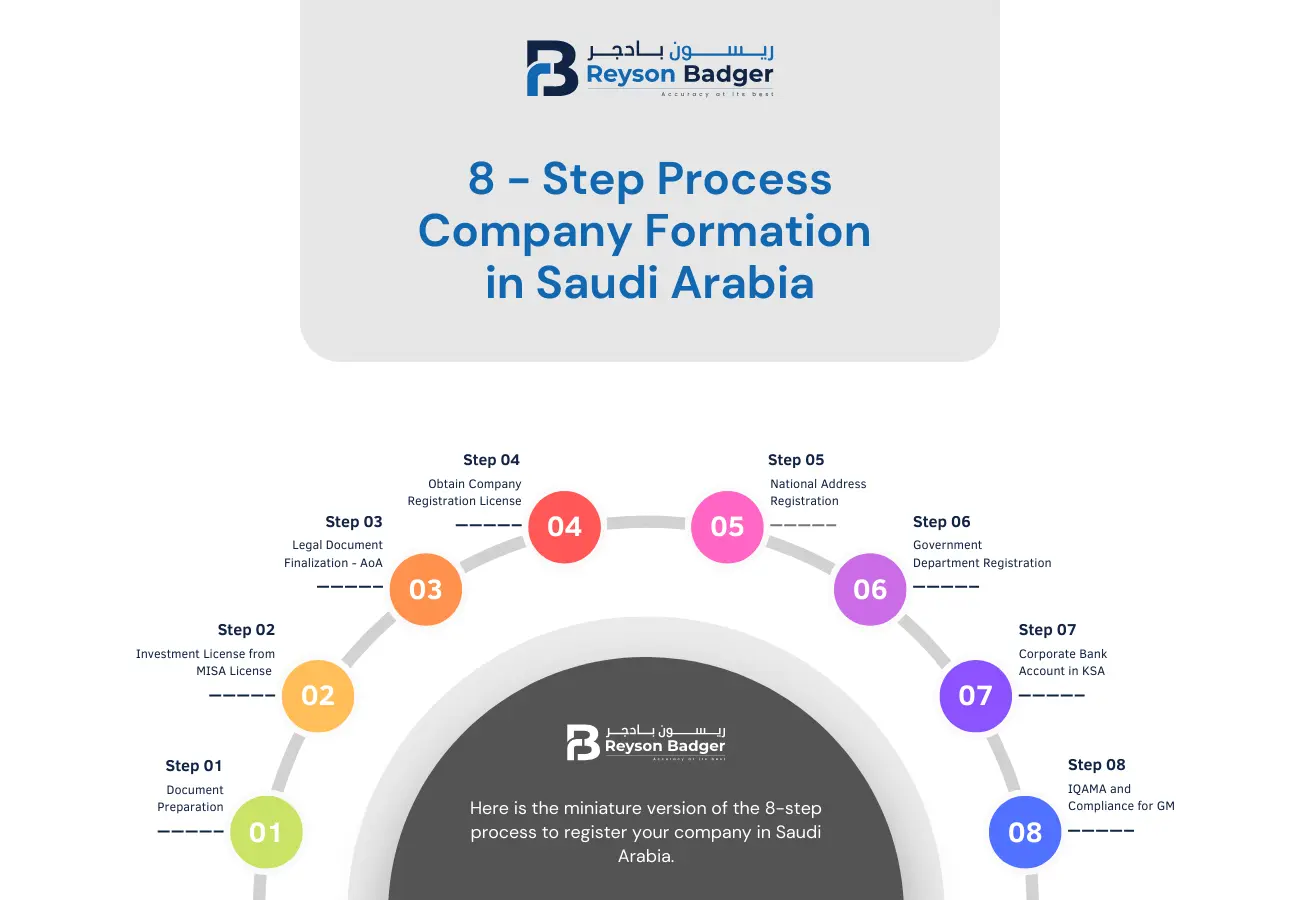
In order for a company to be incorporated in Saudi Arabia, adequate conceptualization is required, as well as the fulfillment of certain regulatory requirements. In this upward economic environment, it is recommended that you take a step-by-step approach to the process of company incorporation. For more information, please refer to the steps listed below.
Step 1: Prepare the documents required for the Company Formation
Step 2: Obtain an investment licence from MISA. MISA is the usual starting point for foreign investors, but processing time depends on completeness and the nature of the business
Step 3: Articles of Association - Finalize the Legal Documentation for the Company
Step 4: Obtain your Company's Commercial Registration License
Step 5: Choose your Business Location and register the national address of your company.
Step 6: Register with the Government departments responsible for taxation, insurance, and employment.
Step 7: Apply for your Corporate Bank Account in KSA
Step 8: Ask the General Manager to visit KSA to get a Residency (IQAMA)
Step 9: Ensure the General Manager is listed on the company's books and with the government.
What are the Factors to Consider while Forming a Company in Saudi?
Local Sponsor: A Saudi Arabian sponsor may be required for certain business activities and structures (such as branches of foreign companies). A sponsor serves as your legal representative and facilitates communication with the authorities on your behalf.
Visas and Work Permits: For foreign employees to work for your company, they will need a work visa and a work permit. Typically, the company is responsible for sponsoring the process.
Business Advisory: Due to the complexity of the process, it is highly recommended that you seek the advice of a professional consultant for company formation in Saudi. A company formation specialist can assist in navigating the legalities, handling documentation, and ensuring that the process is as smooth as possible.
What are the Documents Needed for a Company Formation in Saudi Arabia?
A company name reservation certificate is used to verify that the proposed company name is available and has not already been registered with the Ministry of Commerce and Industry (MOCI).
The Memorandum of Association outlines the company's objectives, capital, and shareholders. The document must be translated into Arabic and notarized.
The internal regulations and management structure of the firm are outlined in the articles of association. Notarization and translation into Arabic are required.
Copies of the firm's stakeholders' and directors' passports.
The commercial registration certificate of each company shareholder and director.
The lease agreement or ownership documents for the company's office or commercial property.
For companies registered by agents or representatives, a power of attorney is required.
What are the Challenges in Setting Up a Business in Saudi?
While setting up a business in Saudi Arabia can be a lucrative venture, there are several challenges that entrepreneurs and businesses may face:
Navigating complex regulations without professional help: SaudiArabiahas a complex regulatory environment, and navigating it without professional guidance can be daunting.
Finding a trustworthy local sponsor: Foreign businesses often require a local sponsor to establish a presence in KSA. Locating a sponsor who is reliable can be a difficult task.
Ensuring compliance with labor laws and tax regulations: Saudi Arabia has strict labor laws and tax regulations. Ensuring compliance with these regulations can be a challenge, especially for foreign businesses.
How Can Consultants Help with Company Formation in KSA?
Professional Company Formation Consultants play a crucial role in helping businesses establish a presence in the Kingdom of Saudi Arabia. Their services include:
1. Assistance with legal documentation and registration: Preparing and submitting necessary documents to register the company with the relevant authorities.
2. Advisory on tax compliance and operational setup:Guiding tax laws, regulations, and operational requirements to ensure compliance and smooth operations.
3. Streamlining the entire process for smooth execution:Coordinating with relevant authorities, preparing necessary documents, and ensuring timely completion of the company formation process. We provide Expert Company Formation services in Saudi Arabia. To know more about services, you can check the services pages shown below:
Company Formation Services in Saudi Arabia
Company Formation in Dammam
Company Formation in Riyadh
Company Formation in Jeddah
MISA License in Saudi Arabia
Business Setup in Ajman Mainland
Bank Account Opening in Saudi Arabia
Dedicated GRO Services in Saudi Arabia
Premium Residency in Saudi Arabia
Commercial Registration in Saudi Arabia
ZATCA Registration in Saudi Arabia
MLSD Registration in Saudi Arabia
Iqama Services in Saudi Arabia
GOSI Registration in Saudi Arabia
Saudisation Consultancy & Employee Transfer Services in Saudi Arabia
Baladiyah approval in Saudi Arabia
Why Choose Reyson Badger To Set Up Your Company in Saudi Arabia?
Choosing Reyson Badger means selecting a trusted partner for your company formation in Saudi Arabia. Our experienced team provides end-to-end guidance, from choosing your company name to securing all necessary licenses and permits. We offer competitive rates, understanding the financial aspects of starting a new venture.
Proven Expertise & Trust
Reyson Badger's strong reputation in Saudi Arabia is built on successfully facilitating smooth company formation. Our client satisfaction speaks volumes, but our credentials truly set us apart. We hold memberships, certifications, and approvals from key professional bodies, government agencies, and numerous major free zones and economic zones. These include affiliations with UAE University, AICPA, ACCA, UAE Ministry of Economy, and approvals as auditors and liquidators for entities like DAFZA, JAFZA, DMCC, and Dubai World Trade Centre, among many others.
Your Path to Success in Saudi Arabia
Partner with Reyson Badger to reach your full business potential in Saudi Arabia. Our comprehensive support and certified expertise ensure a reliable and efficient business setup process, paving your way to success in this thriving market.
FAQs
Starting a business in Saudi Arabia as a foreigner: Is it feasible?
Yes, Obtain an investment licence from the Ministry of Investment of Saudi Arabia (MISA) — the government one-stop body for foreign investment (formerly SAGIA).
What is the difference between an establishment and a Company in Saudi Arabia?
In Saudi Arabia, an establishment is typically a sole proprietorship or small business owned by one person, while a company is a legal entity involving multiple shareholders and has a more complex structure. Companies, such as LLCs, offer limited liability protection, whereas corporations do not.
How much does it cost to launch a company in Saudi Arabia?
Estimated setup costs vary widely by company type, licence, sector approvals and service levels. Smaller setups may start at low tens of thousands SAR, while regulated or capital-intensive projects incur higher costs. Request a tailored quote for an accurate estimate
As a Foreign Investor, can I own 100% of a company in Saudi Arabia?
Yes, Foreigners can obtain 100% ownership in many sectors after securing a MISA investment licence, but some activities remain restricted or conditional. Always verify activity eligibility on MISA’s guidance before planning 100% ownership.
How much time does it take to establish a business in Saudi Arabia?
The time frame for Company Formation in Saudi Arabia varies depending on the type of business and documentation. Generally, it can take 2 to 4 weeks if all requirements are met and documents are submitted correctly.
Do I require a local sponsor for Company Formation in Saudi?
A local sponsor or local commercial presence may still be required for certain structures (e.g., some branches). Under the new investment regime many activities can be fully foreign-owned via a MISA licence — confirm sponsor requirements for your specific activity.
Which Saudi ministries are responsible for setting up a business in Saudi Arabia?
Ministry of Investment (MISA): Issues licenses for foreign investments and oversees foreign investment activities
Ministry of Commerce (MoC):Handles company registration, commercial licenses, and related commercial activities.
Can business activities be combined in Saudi Arabia?
Yes, businesses can combine activities, but the commercial registration must accurately reflect the nature of the business. Each activity must comply with the relevant regulations and licensing requirements.
What types of business structures are available for foreigners?
Limited Liability Company (LLC): Foreigners can own up to 100% in certain sectors.
Branch of a Foreign Company: Many sectors in Saudi Arabia now allow 100% foreign ownership, especially under the Ministry of Investment of Saudi Arabia (MISA) reforms. However, certain sensitive industries remain restricted (e.g., oil exploration, military services, some real‑estate in holy cities). Always check whether your specific activity is open for full foreign ownership.
Joint Stock Company (JSC): Suitable for large enterprises; foreign ownership is subject to specific regulations.
Which entity options are preferred in Saudi Arabia?
LLC: Widely used for small to medium-sized businesses due to its flexibility and limited liability.
Foreign Branch: Preferred for companies seeking to establish a presence without forming a separate legal entity.
Is a local sponsor required to open a branch office in Saudi Arabia?
Yes, a local sponsor is required for a branch office. The sponsor must be a Saudi national or a Saudi-owned company.
What prerequisites must be met to open a branch office in Saudi Arabia?
MISA License: Obtain a license from the Ministry of Investment.
Commercial Registration:Register with the Ministry of Commerce.
Physical Office: Provide a verified physical office address.
Manager: Appoint a branch manager with a valid Saudi residency permit (Iqama).
Bank Account: Open a Saudi business bank account.
Do foreign companies need to invest capital to establish a trading branch in Saudi Arabia?
A minimum Capital requirements for branches and trading branches depend on activity and regulator. Historical figures such as SAR 500,000 were used as guidance for certain trading setups, but exact requirements vary — confirm with MISA/MoC for your specific case.